
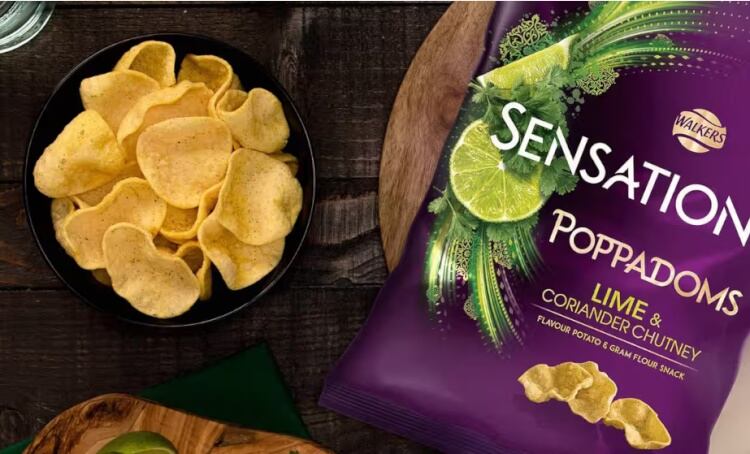
The Sensations poppadom is still a crisp in the eyes of HMRC as Upper Tribunal rules they are subject to the standard rate of VAT after Walkers appeal fails on every ground
Walkers originally lost its case at the First Tier Tribunal (FTT) in January 2024 and has abruptly been knocked back again due to the Walker’s poppadom being 40% made up of potato.
The FTT found the Walkers product, which retails for £2.50 a bag, did not fall within item 1 of Group 1 of Part II of Schedule 8 to the Value Added Tax Act 1994 (VATA) and fell within excepted item 5 Group 1. This includes potato items such as crisps and ‘similar products’.
Both flavours of Walker’s poppadom contained up to 18% potato contents and approximately 40% potato-derived ingredients, leading the FTT to conclude these items were ‘similar products’ to potato items such as crisps and therefore not zero rated.
Barrister for Walkers, Max Schofield, brought eight grounds of appeal to the Upper Tribunal, starting with the FTT erring ‘in its construction of excepted item 5 by applying a broad reading to excepted item 5 and treating products made from potato granules as falling within the item (Ground 1)’.
Scholfield also argued the FTT should not have found the product was made ‘from the potato’, and ‘erred in its application of the test of whether Sensations Poppadoms were “similar products” by asking itself whether the products were “not dissimilar to” potato crisps’.
The barrister then argued the FTT did not consider the products were called a poppadom and not a crisp, and the specific flavours of the poppadom were not used in crisps, as well as gram flour being the main ingredient.
Additionally, Schofield said the FTT ‘misapplied the legal test and failed to give any weight to the manufacturing process’ and ignored ‘fundamental differences between poppadoms and crisps’.
Schofield said: ‘The expression “made from the potato, or from potato flour, or from potato starch” must be given a restricted meaning. The principle of construction encapsulated in the expression “expressio unius est exclusio alterius” applied [Latin for ‘the expression of one thing is the exclusion of another’].
‘The FTT was wrong to find that “potato granules” were included within the words “the potato”,’ he stressed. ‘The only relevant “potato content” was potato starch which accounted for only 17%-18% of the ingredients for Sensations Poppadoms.’
Giselle McGowan, barrister for HMRC argued that the term, ‘the potato’ included the potato granules used within Walkers poppadoms, stating the company had failed to explain why it ‘could extend to slices of potato, but not to granules of potato’, said McGowan.
Judge Richard Meade and Judge Ashley Greenbank both agreed with McGowan here.
Judge Meade said: ‘In the context of legislation relating to VAT, it is well-established that a zero-rating provision or an exemption from VAT should be interpreted strictly.
‘This is because such provisions constitute exceptions to the general principle that all supplies of goods and services made by a taxable person for consideration should be subject to VAT. However, a zero-rating provision or an exemption should not be interpreted so strictly as to deprive the provision of its intended effect.’
Judge Meade went on to say the word potato would incorporate potato granules, and the FTT ‘was entitled’ to reach its original conclusion. ‘Walkers accept that those words are not limited to products made from whole potatoes; they can extend to products made from slices of potato, such as potato crisps’, he added.
Schofield accepted that this could extend to products made from chopped potato, but still refused to accept this extended to potato granules. He argued that there was ‘a point in a manufacturing process at which ingredients derived from potato cease to fall within the term “the potato” and so fall outside excepted item 5 unless they are potato flour or potato starch’.
Walkers also argued that the FTT did not take into account the other ingredients in the product, such as rice flour and gram flour. Schofield pointed out this was ‘unreasonable for the FTT to find’, which was dismissed by the Upper Tribunal.
Judge Meade disagreed, saying: ‘In the present case, we cannot see any basis on which the FTT’s decision on this issue can be impugned.
‘Its finding that the words “made from the potato” can extend to products made from potato granules is neither untenable nor a plain misapplication of the law to the facts.’
It was decided that Walkers poppadoms were predominantly a potato product as the content is up to 40% made from potato, which is double the amount of sunflower oil, the next largest ingredient. It is also more than double the proportion of other dry ingredients.
Grounds three and seven were not argued by Walkers, but all remaining grounds that were argued were dismissed by the Upper Tribunal.
The appeal by Walkers was dismissed.
